One of epistemologist Karl Popper’s (above) most valuable contributions to the philosophy of science was the notion that a theory can never actually be proven true – only false – and that this quality, what he termed falsifiability, is the single defining mark of any theory.
Popper, a former Professor at the London School of Economics, believed that one of the fundamental issues with the scientific method is the confirmation bias: that more evidence in favour of a statement or theory may increase our confidence in it, but does not prove it in any meaningful way. In other words, no matter how many times a theory is supported, one piece of contrary evidence is sufficient, as well as necessary, to unravel the whole idea; that is, to falsify it. Take the statement “All swans are white”, for example. Observing more white swans increases our confidence that the statement is true, but the observation of a single black swan, such as those seen in Australia, falsifies the statement.
This is a powerful idea and one of the most important notions of 20th century philosophy. Essentially, what we all learned in elementary school science class, that we develop a hypothesis and then conduct an experiment to either confirm or contradict the hypothesis is erroneous. We can never fully prove a hypothesis of the observable world, but we can most certainly falsify it.
Which brings us to both of today’s test vehicles. In one corner we have the stalwart of “reliability”, from the brand that practically coined the term in the modern era, the Toyota Tacoma. In the other corner we have the fresh-faced Kia Rio5, one of many in a recent string of thoroughly revamped products from the emergent manufacturer, one with little history of “reliability” to speak of.
And we’re BACK to our regularly scheduled Monday programming.
By Peter Dushenski
I’m indecisive.
That’s how it looks, anyways. Based on the indeterminate scowl that spreads across my normally handsome face whenever I’m thinking in earnest, it’s a fair assumption. But it’s still just an assumption. To my eyes, what’s the rush? I just want to make the best choice I can given the data at my disposal – and that means that I’m rarely inclined to trust my gut– preferring to methodically weigh the merits of delayed gratification vs. instant gratification and head vs. heart. So it’s really not that I’m a slow decision maker, but that I invoke my conscious, rather than unconscious, decision-making mechanisms as frequently as I can. To call it “indecisiveness” is ad hominem at best and distracting to my contemplation at worst.
But, over the Christmas Holidays, when the cheery young Hawaiian man at the Dollar Rental Car counter at the Kahului Airport in Maui asked me if I’d prefer a Dodge Caliber or a Kia Soul, I knew that this decision required no further thought. The only hemming and hawing came when he offered us car insurance. For the fairly pricey sum of $200 for 2 weeks, I did a rough calculation, and decisively resolved to keep my Benjamins firmly in my pocket.
Flipping open the crusty, gummied switchblade key to our 18k mile Soul, the-future-Mrs. CarEnvy (we are recently engaged!) and I tossed our bags into the capacious trunk and set off for Kapalua and our condo on the golf course, or more specifically, our condo on the driving range of the Kapalua Plantation Course: site of the 2012 Hyundai Tournament of Champions.
That’ll be an Audi with the ubiquitous two-litre TFSI engine, then. “Not so fast”, says Kia, a subsidiary of South Korean monolith Hyundai. “It’s a Kia”, they continue, in much the same way that every Optima owner will, on a daily basis, no less. Had Kia actually slapped a “2.0T” badge on the back, instead of the GDI-T (denoting Gas Direct Injection – Turbocharged), Audi would, believe it or not, blush at the comparison.
Even though Audi’s new EA888 has upped its game to 211hp and 258lb-ft, the GDI-T utterly trumps that with 274hp and 269lb-ft thanks to direct injection, a sizeable intercooler, and a twin-scroll turbocharger. That Kia badge is suddenly less funny. But where the Audi is all-wheel drive, the Optima is resolutely a front driver. This important difference ensures that the Optima will be rightly compared to the likes of Honda’s Accord and Ford’s Fusion, rather than the more premium nameplates its sultry lines suggest.
Power is routed to those character-defining front wheels through the standard 6-speed automatic, developed in-house, which handles the boosty power delivery assuredly. Paddle shifters behind the steering wheel casually target ratios with all the self-important indifference of snooty British Royalty, which is to say that they can’t be bothered to work. This is probably for the best, because the Optima doesn’t ask its driver to grab it by the scruff of its neck and give it a good shagging, it asks the driver to feel good because he looks good, but more on the looks in a minute. The steering is partly to blame for the lack of enthusiasm; it has some heft to it, but its inaccuracy means that it doesn’t mask the size of the vehicle as well as the small-diameter rim might suggest.
Above is a Scanning Electron Micrograph (SEM) of the Jason Castriota Virus, also known as JCV.
We have something of a Jason Castriota Virus (JCV) problem on our hands. With the over-wrought media flap that was the H1N1 Swine Flu pandemic still fresh in our minds, it appears that we have conquered one viral scare only to face another.
H1N1 was feared to be as deadly and contagious as the 1918 Spanish Flu, that which claimed more lives than the preceding Great War. Interestingly, the Spanish Flu was so named because Spain’s King Alfonso XIII was the highest profile patient and Spain received significant news coverage of the disease, not because it originated in Spain. The Spanish Flu is hypothesized to have originated in either Kansas, China, or France, although the exact source is not definitively known, whereas the exact source of H1N1 is a Mexican pig.
On the other hand, the exact source of JCV is Cambiano, Italy, home of fabled design house Pininfarina. Unlike the misnomered Spanish Flu, JCV suffers from no such incertitude of nomenclature – there is no doubt that Jason Castriota, during his tenure at Pininfarina, was directly responsible for the current crop of infectious taillight designs spreading from west to east, culminating in the current pandemic.
Say goodbye to Kia’s hackazoarus E-Class poseur, the Amanti, and say hello to the Cadenza (which looks remarkably like the KND-5 concept we saw in April). If you’re wondering why it looks so sharp, so Teutonic, look no further than Kia’s current design director Peter Schreyer. On this man’s back alone, Kia is poised to reinvigorate the inexpensive car segment. Together with parent company Hyundai’s supreme powertrain development (most notably with GDI), Kia is doing what Honda did in the early 70′s.
For those self-loathers in need of an Amanti memory refresh, see below.
Let’s pretend for a second that you’re one of those people who don’t read the titles of articles. Now, take a good look at this picture and see if you can guess who makes it. Keep in mind that it is a concept, albeit a thinly-veiled one. Notice the character line along the profile, the shapely headlights, the Audi-esque front diffuser, and the overall attractiveness of the design. Speaking of Audi, just wait until you see the taillights. There’s more than a little B8 A4/A5 in them.
So make your guess and follow the jump to see if you’re right!
The new 2009 Audi S4 is perfectly good supercharged sedan that is a healthy addition to the A4 range. It’s no RS4 but I can understand the need for an “S” variant in the line-up, if only to bridge the gap between the slightly over-priced A4 and the severly over-priced RS4.
These days, Audi is one of the few companies that is actually increasing its marketing efforts. Only Hyundai/Kia are doing the same, while the rest of the industry is cutting back in an effort to stay in the black. Apparently the marketing assault is working because Kia, Hyundai, and Audi are weathering the storm better than almost any other manufacturer in this harsh economic climate.
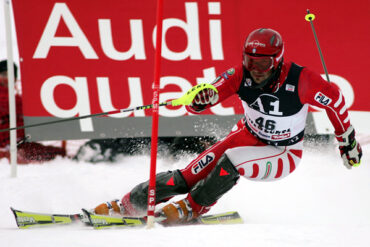
Audi’s latest marketing bit takes us to the ski slopes. It probably isn’t shot in the Rockies, but I won’t count it out as anti-Canadian just yet. The video features Audi-branded skis (and skier) going against an Audi-branded car. Which brand will win? (Spoiler alert: Audi)
But will man be able to beat machine? You’ll have to follow the jump to find that one out
GM goes down 53%. Chrysler plummets 44%. Ford falls 48%. Toyota sees a 40% decline. And Honda and Nissan are the month’s “winners” in terms of drops, at 38% and 37% (dis)respectively. Although Hyundai/Kia bucked the trend and showed a small gain for February.
Overall though, production numbers for the quarter continues to dwindle. The giants of the auto industry just saw their worst month since December 1981 – remember that time? When Michael Jackson was black? When Ronald Reagan was just getting over his assassination attempt? When a little show by the name of “Family Ties’ was about to debut on NBC?
Yeah, long time ago. The thing is, is anyone really surprised at this point?